International Baccalaureate (IB)
Through the challenging, enquiry-based, student-centered, globally-minded framework of the International Baccalaureate, we develop well-rounded, critical thinkers and global citizens who think and see the world differently.
The IB plays an integral part in fulfilling ISCreson’s mission, and in developing compassionate and curious global citizens. In a way, IB is the language all of our students speak.
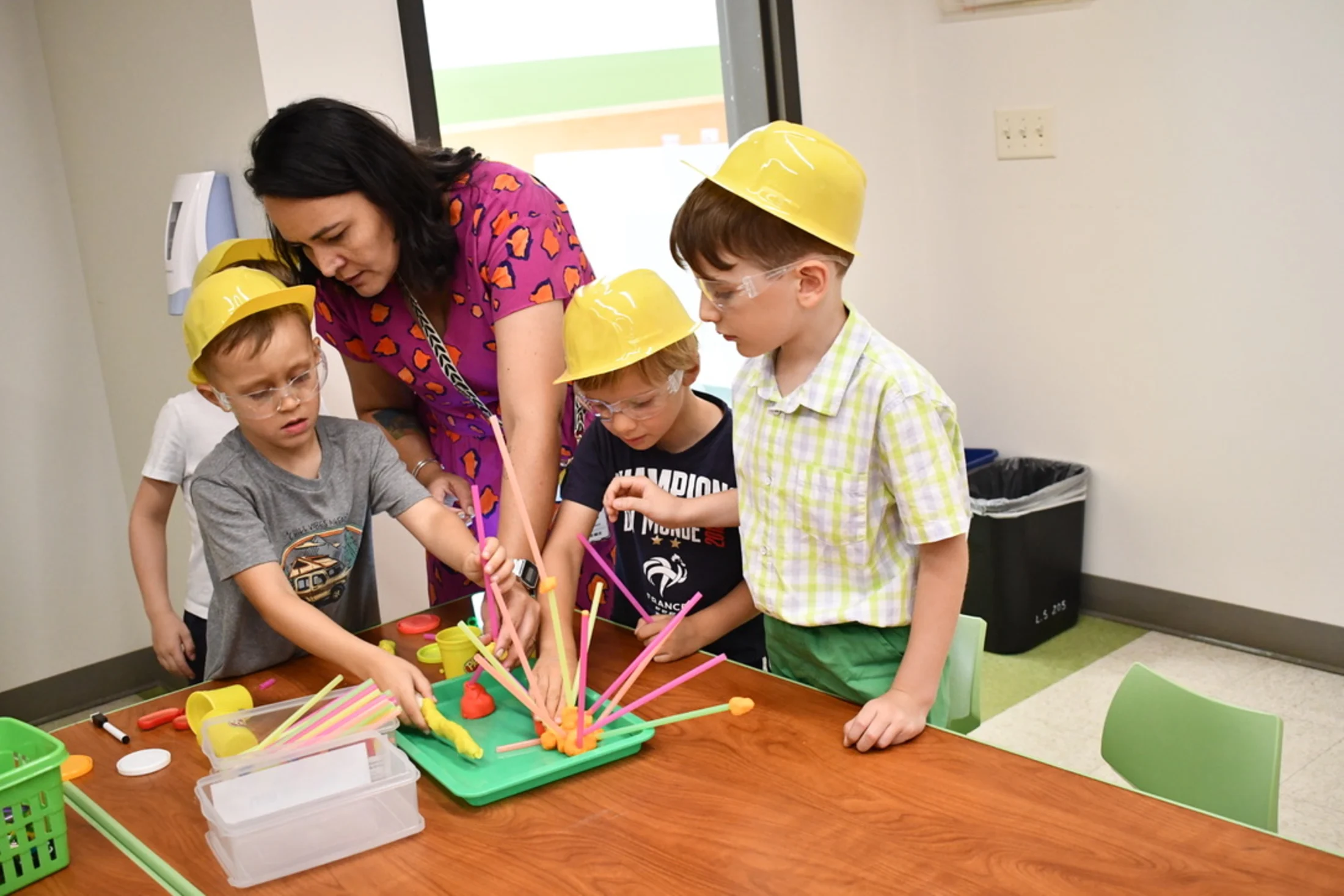
ISCreson uses the IB as a framework for delivering our curriculum in a language immersion setting - through our fully authorized Primary Years Programme (PYP) for ECE – G5, and in our fully authorized Middle Years Programme in our Middle School (G6 – G8)
International School of Creson is a fully authorized IB World School—as of Fall of 2022.
IB World Schools share a common philosophy—a commitment to improve the teaching and learning of a diverse and inclusive community of students by delivering challenging, high quality programmes of international education that share a powerful vision.
ISCreson is currently authorized to offer the International Baccalaureate (IB) Primary Years Programme (3 Years - Grade 5) and the Middle Years Programme (Grades 6 – 10). We are now a candidate school for the Diploma Programme for Grades 11 and 12. Only schools authorized by the IB Organization can offer any of its four academic programmes: the Primary Years Programme (PYP), the Middle Years Programme (MYP), the Diploma Programme (DP), or the Career-related Programme (CP). Candidate status gives no guarantee that authorization will be granted. For further information about the IB and its programmes, visit www.ibo.org.
All About IB Education
As an International Baccalaureate® (IB) World School, we adhere to the six IB approaches to teaching, and five IB approaches to learning.
Approaches to Teaching
-
DEVELOPED IN LOCAL & GLOBAL CONTEXTS: Teaching uses real-life contexts and examples, and studentsare encouraged to process new information by connecting it to their own experiences and to the world around them.
-
FOCUSED ON CONCEPTUAL UNDERSTANDING: Concepts are explored in order to both deepen disciplinary understanding and to help students make connections and transfer learning to new contexts.
-
BASED ON ENQUIRY: A strong emphasis is placed on students finding their own information and constructing their own understandings.
-
FOCUSED ON EFFECTIVE TEAMWORK & COLLABORATION: This includes promoting teamwork and collaboration between students, but also refers to the collaborative relationship between teachers and students.
-
DESIGNED TO REMOVE BARRIERS TO LEARNING: Teaching is inclusive and values diversity. It affirms students’ identities and aims to create learning opportunities that enable every student to develop and pursue appropriate personal goals.
-
INFORMED BY ASSESSMENT: Assessment plays a crucial role in supporting, as well as measuring, learning. This approach also recognizes the crucial role of providing students with effective feedback.
Approaches to Learning
-
THINKING SKILLS: Including areas such as critical thinking, creative thinking, and ethical thinking.
-
RESEARCH SKILLS: Including skills such as comparing, contrasting, validating, and prioritizing information.
-
COMMUNICATION SKILLS: Including skills such as written and oral communication, effective listening, and formulating arguments.
-
FOCUSED ON EFFECTIVE TEAMWORK & COLLABORATION: This includes promoting teamwork and collaboration between students, but also refers to the collaborative relationship between teachers and students.
-
SELF-MANAGEMENT SKILLS: Including both organizational skills, such as managing time and tasks, and affective skills, such as managing state of mind and motivation.
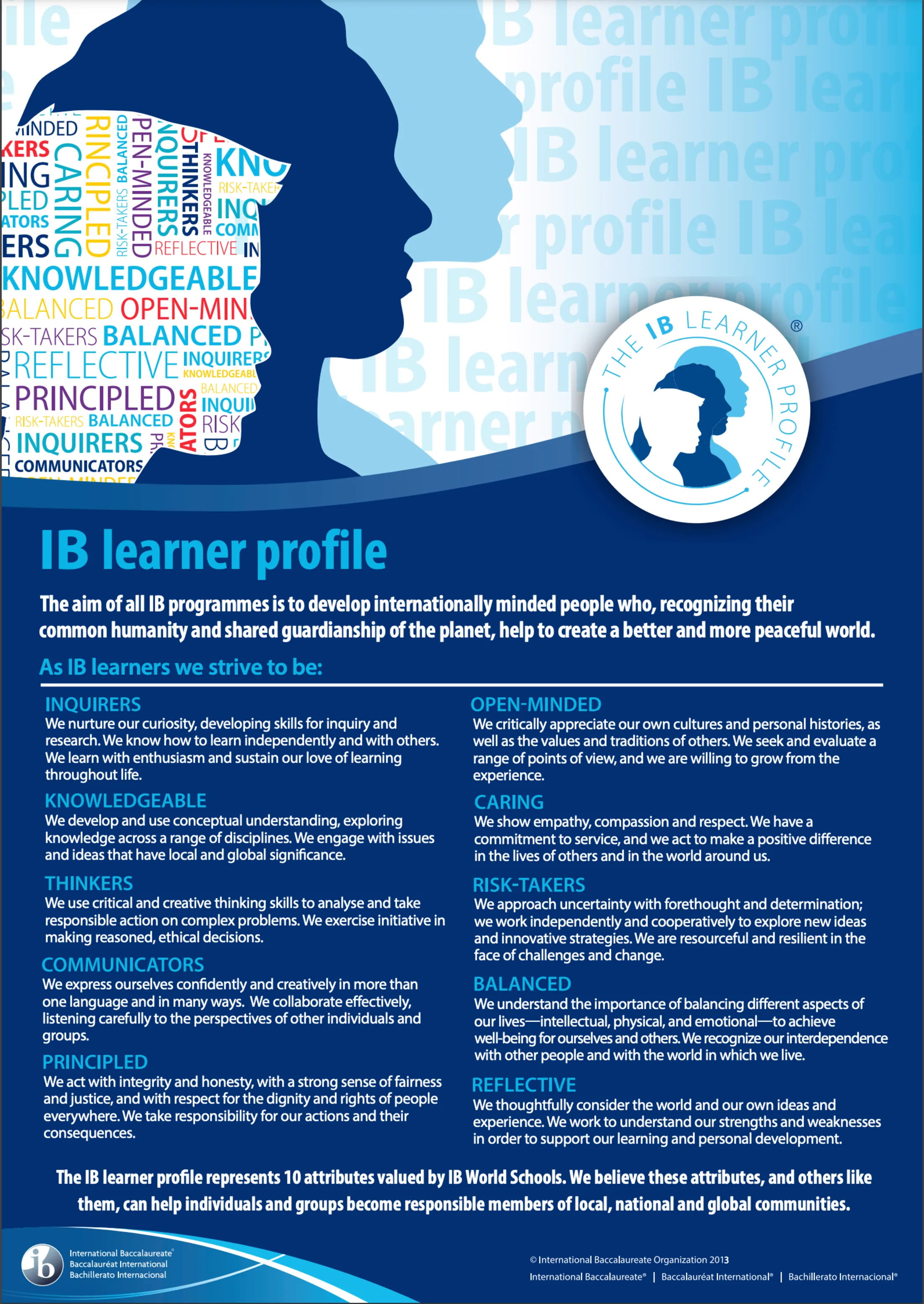
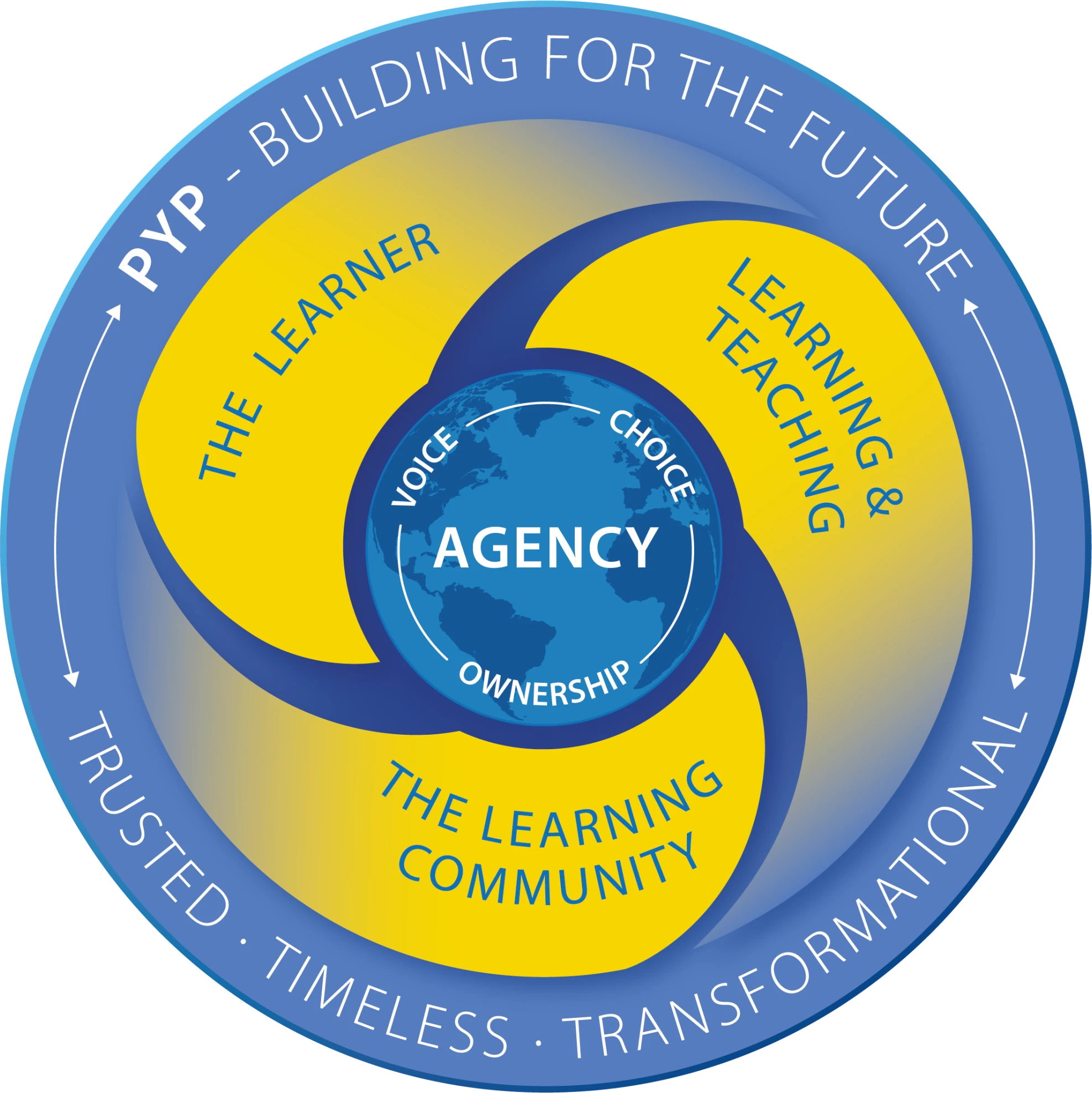
The PYP is a curriculum framework for young learners aged 3 – 12. Like all International Baccalaureate (IB) programmes, the IB learner profile permeates all facets of school life in the PYP.
The PYP is based on the recognition of a child’s natural curiosity, creativity and ability to reflect. It generates a stimulating, challenging learning environment to nurture the whole child and foster a lifelong love of learning for all.
The PYP is transdisciplinary, meaning students learn across subject areas while enquiring into big ideas.
The PYP develops students’ academic, social and emotional wellbeing, focusing on international-mindedness and strong personal values. Students learn traditional subjects with emphasis on real-life situations, decision-making, problem solving, research, and action. The program incorporates local and global issues into the curriculum, asking students to look at related, transdisciplinary themes and to consider the links between them.
In the early years, students learn through doing (e.g., playing), as active participants in their learning. The power of play is the primary vehicle for enquiry, supporting thoughtful and intentional opportunities for child-initiated play, hands-on learning, and the co-construction of learning between teachers and young learners. Students learn to enquire as they build and test theories to help make sense of the world around them.
As students move through the PYP program, they’re asked to construct their own meaning independently, helping to develop a deeper and more profound understanding of the subjects they study. Within each unit of enquiry, students and teachers together identify together what they want to know, what they already know, what they need to know, and how they might best find that out. This encourages students to see connections between subjects.
More about the IB PYPThe curriculum is guided by six transdisciplinary themes of global significance. This means that students deepen their learning by developing their conceptual understandings; strengthening their knowledge and skills between, across and beyond subject areas. The transdisciplinary nature of these themes allows the students to explore issues across the languages and subject areas, encourage them to engage in a curriculum that is engaging, challenging, significant, and relevant to the real world, while also incorporating the attributes of the IB Learner Profile.
The six themes are:
-
Who we are
-
Where we are in place and time
-
How we express ourselves
-
How the world works
-
How we organize ourselves
-
Sharing the planet
Each PYP unit begins by assessing students’ prior knowledge on a central idea and pre-determined lines of enquiry. Then the students formulate questions based on what they want to know about the topic.
Those student questions start the cycle of enquiry that guides every PYP lesson. Teachers support the student-led enquiry with age-appropriate resources and activities to guide and structure the learning. It’s an approach that works at every grade level to provide challenges for every student.
Example: ISCreson Program of Enquiry (POI) for K1 – G5, 2021-22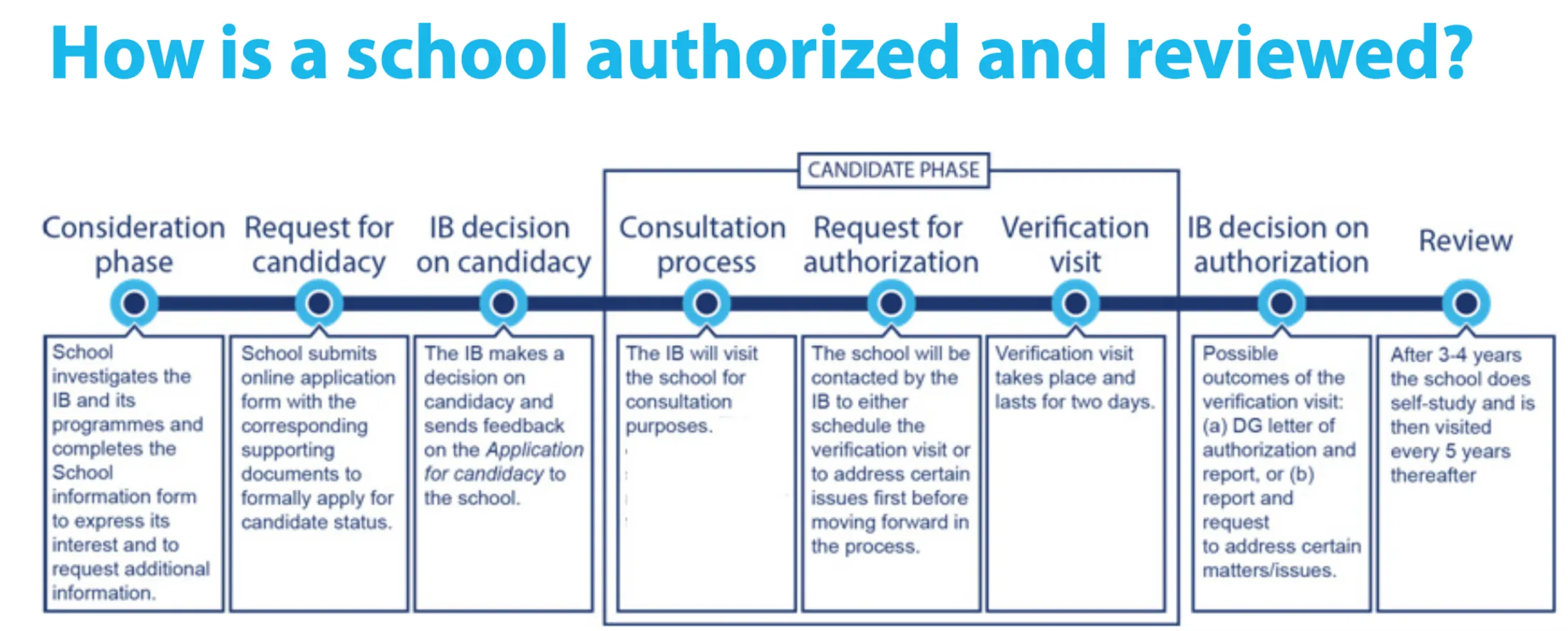
-
Phase one: ISCreson began the process of aligning all of the curriculum in the ECE and Grades 1 – 5 to ensure we follow the standards of China, France, Spain, and the United States within the PYP curriculum framework. Approximately half of the teaching staff received the Making PYP Happen in the Classroom professional development.
-
Phase two: Became a candidate PYP school, 2020.
-
Phase three: Continue to align the curriculum in ECE – G5, within the PYP curriculum framework. Develop the transdisciplinary themes at every level. Continue to provide professional development for teachers. Launch parent education programs.
-
Phase four (we are here!): Completed PYP authorization; fall 2022.
Our International Baccalaureate Middle Years Programme (IB MYP) is a seamless continuation of elementary learning at ISCreson, and engages students in small classes, using hands-on learning and technology.
-
Within the MYP structure, we continue to focus strongly on the development of bilingualism, while building international-mindedness. We capitalize on the students’ broad knowledge base and help them apply their diverse approaches to learning to reinforce a focus on global citizenship.
-
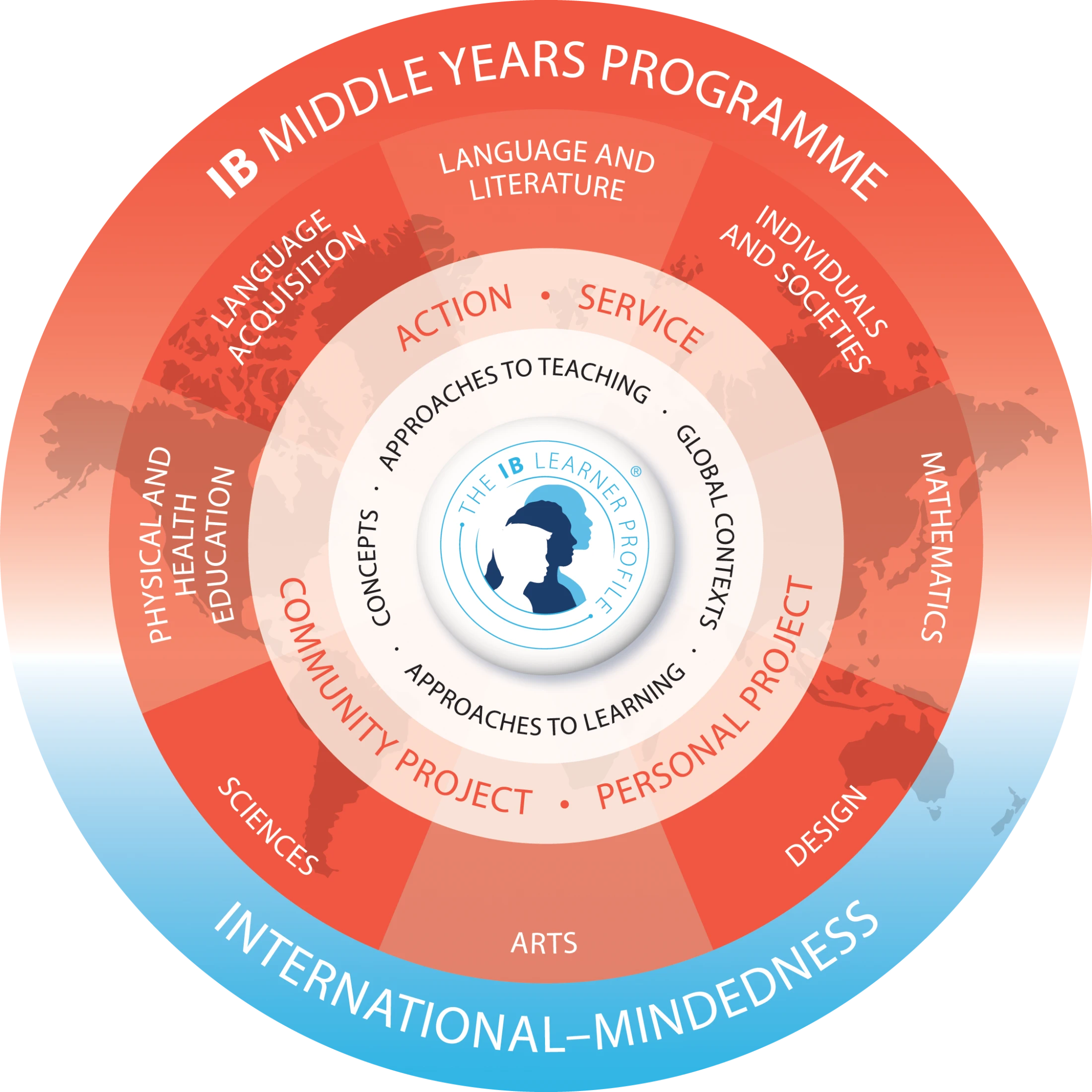
The interdisciplinary framework of the IB MYP—consisting of language acquisition, language and literature, individuals and societies, sciences, mathematics, arts, physical and health education, and design—draws on authentic connections between the eight subjects to make learning more meaningful for our students. ISCreson students understand how math and science relate to arts and humanities, and are able to apply their lessons to life outside the classroom.
-
Additionally, we offer both novice- and advanced-level, intensive foreign-language instruction in French, Chinese, and Spanish to our 6th, 7th, and 8th grade students. New students are not required to have any prior foreign-language experience prior to joining the MYP.
-
The IB MYP’s focus on service, character development and global perspectives culminates in an annual community project and Spring service learning trip abroad. On the heels of the broad, balanced, and rigorous curriculum, our 8th grade students are well prepared to meet the challenges of high school; 87% are admitted to their high school of choice, with many electing to continue their IB educational journey at a local IB World School.
'ISCreson is a very special and unique place. We teach languages - language acquisition is our “secret sauce” - but we are so much more than a language school. We create global citizens who are at home in the world, both inside and outside of our classrooms.' Bob Carig, Head of School
Our language policy provides an overview and guiding principles for language learning at ISCreson which permeates the entire school curriculum through authentic contexts in a culturally rich and diverse environment. At ISCreson, we use a Content and Language Integrated Learning (CLIL) methodology for the learning of the language in Primary School and MYP social studies.
A variety of assessment strategies are used by teachers to inform their teaching as well as to understand what students have learned. A key component of assessment practices includes both teacher and student reflection and self-assessment in order to provide feedback on the learning process.
IB Resources
IB Alumni Perspectives
As part of the International Baccalaureate's 50th anniversary, they celebrated by filming some of their alumni who went on to do incredible things every day to make their community—and the world—a better, more peaceful place.These are just a few who represent what it means to be an IB graduate, and what it means to put the skills learned in the IB into practice.